

Showing posts with label Shahid Siddiqui. Show all posts
Showing posts with label Shahid Siddiqui. Show all posts
Tuesday, June 4, 2019


Saturday, May 25, 2019
TEACHER – A “NEVERTIREE” by SHAGUFTA TAHIR
TEACHER – A “NEVERTIREE”
Ms. Shagufta Tahir
Head of Department of English
Army Burn Hall College for Girls Abbottabad

It was 2002, probably it was. The big clock on the wall facing the
audience was steadily ticking: 08:30am. The hall was echoing with the voices
that were both excited and quizzical. Among scores of faces, a few had a trace
of familiarity in them, which bore the stamp of approval when smiles were
exchanged. I checked the schedule of the programme, yawned to see that all five
sessions of one hour each, from 09:00am to 02:30pm, would be by one person–SKS!
“Who's this S.K.S?" I thought and started scribbling something on a
separate sheet of paper to pass my time. It was the first day of Diploma TEFL
workshop in the main campus of Allama Iqbal Open University, Islamabad. I was
one of many others who had congregated upon the venue form all over the country
for the fulfillment of the course requirement. Going by the given schedule, the
first day did not bode well for me and of course, for a few others like me.
Nonetheless, we all were waiting for the mystery man!
‘A teacher is an undying spirit, an inextinguishable flame. Teacher is – a “NEVERTIREE”!’
At exact 9 o’clock, the door opened and a middle-aged spectacled
man entered the hall with a bag in his hand. There was something in his
personality that stopped the whispering tongues and there fell a reverent
silence on those present. During his brief self-introduction, the secret was
out that his name was Shahid Kaleem Siddiqui and he was a professor at Ghulam
Khan Institute, Topi. He started his first session, “Teacher Development” with
the ice breaking activity. First, he made us sit in a semi-circle and divided
us in pairs. Then he drew his hand on the board and asked us to do the same on
a paper. A wave of curiosity ran through the participants of the workshop. In
each of the fingers drawn on the board. He wrote his name, qualification,
experience, favourite colour and favourite book, respectively. We did the same
for us. He asked us to swap our paper with the person on the next seat and read
aloud while transforming words into complete sentences. How nicely he made us introduce
each other and practice language creatively! I did not know how those five
hours (there was a 30-minute break from 11:00am–11:30am) hurried away. In each
of the sessions, we really learnt techniques of teaching in addition to the
content-related knowledge. He, through practical demonstration, showed us the
difference between conventional teacher, who refuses to leave his rostrum,
pours his “knowledge” into the “minds” of his students without using any
teaching strategy, and the “real” teacher, who “teaches” in every way: through
his personality, his behaviour, his words, his interactive measures, his
gestures and even when he is quiet.
Apart from “Teacher Development” we had workshops on “Lesson
Planning”, “Classroom Dynamics” and “Introduction to Teaching Practice”. On one
hand, there was theoretical knowledge conveyed to us, but on the other hand,
there was so much that a “real” teacher needed to apply in the classroom to
make teaching-learning a creative and exciting experience. He proved that it is
not only “WHAT” we tell our students in our class, but “HOW” we say and do that matters most.
During his lectures and presentations, he would walk among us,
make us work individually, in pairs and groups, would use the most
sophisticated language sprinkled with humour, ask questions unexpectedly by
calling our names, encourage and appreciate our responses, give us time to
rethink and come up again with the better answer, would allow us to communicate
(strictly in English) and discuss our points meanwhile observe us silently. His
use of audio-visual aids was a learning of its own kind. And at the end of the
day-long sessions, I can safely bet there was hardly anyone who complained of
boredom, fatigue or lethargy. When our “real” teacher had been active and
lively, how his students could be running short of energy!
The rest of five days (Saturday used to be working day in those
days) were also rewarding in one way or the other. However, the taste of that
day is still fresh. The colours that Dr. Shahid added still have their hues,
words he uttered in the hall still have their echo, and lessons I learnt that
day are not easy to forget. That was the day when I came to know how sacred a
profession teaching is! How artistic a job it must be! Even now, wherever I
meet him, I do tell him in all my humility what an inspiration he has been! I
tell him that the day when teaching no longer remained a dull profession for me
and became a worship, was THAT day! If today, any of my students see even a
little sparkle in my eyes when I teach, it is not mine; it is what I have been
granted!
Whenever I ask Sir Shahid what a true teacher is, he smiles and
says, ‘A teacher is an undying spirit, an inextinguishable flame. Teacher is – a
“NEVERTIREE”!’
Note: This article was written for Burn Hall college magazine in
2014.
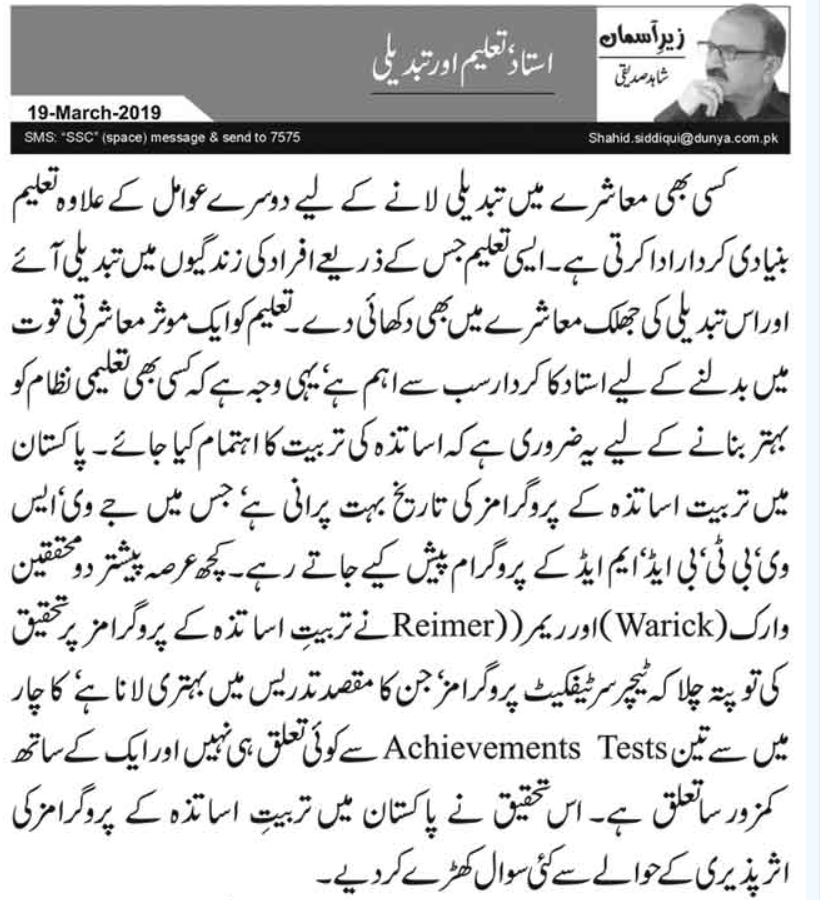
Monday, March 18, 2019

Monday, January 21, 2019

Friday, November 23, 2018

Thursday, November 22, 2018

Saturday, November 10, 2018

Monday, November 5, 2018

Sunday, November 4, 2018

Friday, November 2, 2018


Monday, October 29, 2018

شاہد صدیقی: مرکزی شہر کا تعلیمی مرکزہ
پروفیسر نعیم مسعود کا کالم
شاہد صدیقی: مرکزی شہر کا تعلیمی مرکزہ
28 اکتوبر 2018 2018-10-28
تعلیمی ہیراپھیریاں ریاست میں ناگن جیسی بیورو کریسی، زہر آلود سیاست، جان لیوا کرپشن اور کوڑھ کی کاشت والی مطلق العنانیت کو عام کرتی ہیں۔ مثبت تعلیم و تحقیق اور کمیونٹی سنٹرز اور مراکز بننے والے تعلیمی ادارے اور یونیورسٹیاں بگاڑ کو پاش پاش کر کے بناؤ کے جاندار و جاندار دریچے کھولتے ہیں، یہی جمہوریت، یہی ملکی و ذاتی دفاع اور گھر سے ریاست تک کی اقتصادیات کو دوام بخشتے ہیں۔ جہاں تعلیم و تحقیق عشق ہوں وہاں کبھی زوال کا بسیرا ممکن ہی نہیں!
شہر اقتدار میں جب کبھی جاؤں تو یہ معمول ہے کہ ایچ ای سی، پاکستان انسٹیٹیوٹ آف پارلیمنٹری سروسز (PIPS) اور پنجاب ہاؤس کا چکر ضرور لگتا ہے لیکن گزشتہ تین چار سالوں سے علامہ اقبال اوپن یونیورسٹی بھی اس فہرست میں شامل ہے۔ حلق یاراں سے اسلام آباد جانے والے احباب اکثر مذاق اڑاتے ہیں کہ، میں سیاسی پنڈتوں کے درشن اور ایوان اقتدار کے جھلملاتے اور مہکتے مہکاتے لوگوں کے دیدار کئے بغیر واپس لاہور لوٹ آتا ہوں۔ حالانکہ سابق دور حکومت میں کچھ دوستوں کے پاس وزارتی قلمدان بھی تھے اور ان کی جانب سے دعوت عام اور دعوت خاص بھی ہوتی مگر ہم شاید ان کی طرز میزبانی اور طرز حکمرانی کو ایک ہی زاویے سے دیکھنے کے مرض میں مبتلا تھے سو زیارتوں کا حوصلہ نہ رکھتے۔ گویا ایسے دلرباؤں کی شیریں بیانیاں و خوش الحانیاں عملی طور پر صفر تاہم قولی طور پر " ڈائیا بیٹک " کے علاوہ کچھ نہیں ہوتیں۔ ناروے کے شہر اوسلو میں جب چار سال قبل سابق ڈپٹی سپیکر قومی اسمبلی اور موجودہ ایم این اے مرتضیٰ جاوید عباسی سے ملاقات ہوئی تو اس "رولنگ" جاری کی، آئندہ آپ جب اسلام آباد آئیں گے تو میری میزبانی کے علاوہ کسی اور کی میزبانی کو قبول نہیں کریں گے۔ کہتے تو وہ بھی بہت تھے مگر ہم جانتے ہیں کچھ سیاسی بوقت ضرورت غیر سماجی ہو جاتے ہیں لہذا کئی بیماریوں کے علاج سے پرہیز بہتر ہوتا ہے۔ دو لوگ اسلام آباد میں ہمیں ایسے ملے جن سے تعلق پرانا تو نہ تھا مگر گہرا بہت تھا۔ کوئی ضروری نہیں کہ پرانے تعلق بزرگ بھی ہوں بس اکثر بوڑھے ہی ہوتے ہیں۔ بہرحال عباسی صاحب اور ڈاکٹر شاید صدیقی کے دونوں اس قدر محبت کرنے والے لوگ ہیں کہ ان پر شک کرنا بھی تعزیرات کے زمرے میں آتا ہے مگر ہم اپنی آمد کا مرتضیٰ جاوید عباسی کو بتاتے نہ اور شاہد صدیقی سے چھپاتے نہ۔ مرتضی جاوید عباسی کاشیڈول اور ایکوسسٹم بڑے پیچیدہ لگتے اور صدیقی صاحب کے بہت فہمیدہ!
کم و بیش ساڑھے تین سال قبل میں لاہور سے بطور خاص ماروی میمن چئرمین بیں ظیر انکم سپورٹ پروگرام اور اس وقت کے وزیر مملکت برائے تعلیم و داخلہ انجنئر بلیغ الرحمن کو ملنے گیا۔ مگر ان ملاقاتوں کے بات بہت مایوسی ہوئی کیونکہ دونوں کے وڑن اور عمل میں زمین و آسمان کا فرق تھا۔ سوچا غم غلط کرنے کیلئے اس وقت کے چیئرمین ہائر ایجوکیشن کمیشن ڈاکٹر مختار احمد سے ملتے ہیں۔ وہ مصروف تھے پس انہوں نے علامہ اقبال اوپن یونیورسٹی کی تقریب ہی میں مدعو کرلیا۔ پہنچا تو انہوں نے سٹیج ہی پر بلا لیا۔ میرے لئے کسی مہربان نے رئیس جامعہ والی نشست خالی کردی اور حسن اتفاق کہ میں ڈاکٹر صدیقیکے ساتھ بیٹھ گیا۔ آنکھیں لڑیں اور کچھ ملیں بھی۔ سیل فون نمبروں کا تبادلہ ہوا۔ ڈاکٹر صاحب سے بالمشافہ یہ پہلی ملاقات تھی اس سے قبل میرا ان سے یکطرفہ ملن بطور قاری انگریزی و اردو کالموں اور کتابوں ہی میں تھا۔
جب کبھی فون کیا صدیقی صاحب دفتر میں موجود۔ پورے خار سال کے وائس چانسلرانہ دور میں ایک بھی چھٹی نہیں۔ ٹھیک 8 بجے صبح آجاتے اور سر شام واپس لوٹتے۔ وی سی حضرات کے بیرون ملک کے بہت دورے ہوتے ہیں لیکن یہ صرف ایک دفعہ گئے۔ کہتے کہ سیٹ پر رہنا باہر جانے سے زیادہ ضروری ہوتا ہے۔ مجھے ان کے پاس ہر دفعہ جانا اس لئے اچھا لگتا کہ سیکھنے کو کوئی نئی چیز ملتی۔ وہ ریفارمز کے آدمی ہیں۔ قلم و قرطاس سے انہیں پیار ہے۔ مزاج میں سلیقگی، تعلقات میں تازگی، گفتگو میں شگفتگی، اردو و انگریزی ادب سے وابستگی اور گفتگو میں شعر و شاعری ایسے ٹانکتے ہیں جیسے مولانا ابو الکلام آزاد اپنی تحریروں بالخصوص " غبار خاطر " پروئے۔
اہل نظر اس بات سے آشنا ہیں کہ کئی وی سی، وی سی کم اور "وی سی آر" زیادہ لگتے ہیں تاہم ڈاکٹر شاہد صدیقی ہمیشہ ایک سالم وی سی لگے! 2014 تا اکتوبر 2018 یونیورسٹی کا وی تاریخ ساز دور ہے جس میں شہر اقتدار کا یہ ادارہ تعلیمی و تربیتی و تحقیقی و ادبی سرگرمیوں کا گہوارہ بنا دہا، تقریباً 39 ریسرچ کانفرنسیں، 17 ریسرچ جرنلز، 2 سو سے زائد سیمینار اور تحقیقی مقالوں میں سو گنا اضافہ بیمثال اعزازات کا حصول ہے۔ وہ لائبریری جو ساری عمر سہ پہر 4 بجے بند ہوجاتی اب تحقیق کاروں کی مدد کیلئے شام 7 بجے تک کھلی رہتی۔ غریب یتیم بچوں کیلئے تعلیمی سہولت مفت کی گئیں۔ نابینا اور بہرے طلبا و طالبات کیلئے جدید لیبز اور لائبریری بنائی گئی۔ لگ بھگ پندرہ لاکھ طلبہ زیور تعلیم سے آراستہ ہوئے ہیں۔ بلوچستان اور فاٹا کے طلبہ کو میٹرک سطح رکنیت تعلیم کی فراہمی جیسا قابل ستائش قدم ڈاکٹر صدیقی کی تعلیم دوستی کا منہ بولتا ثبوت ہے۔ سپورٹ سسٹم ، کمپلینٹ مینجمنٹ سسٹم اور پروفیشنل ٹریننگ کی بہتری کو خوب رواج بخشا گیا۔ آن لائین داخلوں اور امتحانی نظام میں اصلاحات لانا بھی حسن کارکردگی کا منہ بولتا ثبوت ہے۔ بطور خاص ملکی و غیر ملکی اداروں سے معاونت کا پہلو بھی قابل تعریف پیش رفت تھی۔
واقعی جامعہ کو ایک کمیونٹی سنٹر بنا ڈالا۔ ایک ہزار سے زائد جیل کے قیدیوں کو فراہمی تعلیم کا بندوبست کرنے پر ڈاکٹر صدیقی قیدی طلبہ کے استاد بھی قرار پائے۔ سی پیک تناظر میں دیکھیں، تو گوادر ، ملتان اور اسلام آباد میں سنٹر برائے چینی لینگوئج اور کلچر کا اہتمام کمال سرگرمی ہے۔ ریٹائرمنٹ کے بعد ملازمین کیلئے خصوصی لاؤنج بنایا گیا۔ بے بی کئیر سنٹر کی سہولت، AIOU فاؤنڈیشن کا آغاز، عمرہ سکیم کا اجراء4 ، آن لائن پینشن، ایگزیکٹو کلب کا قیام اور میڈیکل پالیسی میں اصلاحات جیسے متعدد امور استاد سے ہیومن رائٹس تک کے معاملات میں بہتری کی بنیاد رکھنے کے مترادف ہے۔ ورکرز کی رہائشوں سے فٹنس تک کے معاملات کو مدنظر رکھا گیا۔
راقم کو متعدد دفعہ ڈاکٹر شاہد صدیقی کو سننے اور سمجھنے کا موقع ملا، کئی سیمینار میں ان کی سنگت رہی، مجھے وہ تین سال قبل کے وہ لمحات بھی اچھی طرح یاد ہیں جب ڈاکٹر مختار احمد نے بحثیت چئرمین پاکستان ہائر ایجوکیشن کمیشن نے لاہور میں آل پاکستان وی سی کانفرنس کا انعقاد کیا جس کے سیشن میں راقم کو بھی پاکستان بھر کے وائس چانسلرز سے مخاطب ہونے کا موقع ملا۔ دیگر مقررین میں مجیب الرحمن شامی، امجد اسلام امجد، ڈاکٹر صغرا صدف، یاسر پیرزادہ اور حبیب اکرم نے بھی اظہار خیال کیا اس سیشن کی کمانڈ ڈاکٹر زاہد صدیقی کے پاس تھی اور وہ اس موقع پر ایک وقت استاد، محقق، دانشور، مصنف ،صحافی اور وائس چانسلر بھی لگے۔ یہ میری ان سے دوسری ملاقات کا تاثر اور انکشاف تھا کہ، پرفیکٹ میں فار پرفیکٹ جاب۔ اس سارے منظر نامہ کو اس وقت میں نے اپنے نوائے وقت کالم میں بھی کندہ کیا تھا۔ سیانے کہتے ہیں کہ حسن وہ ہے جس کی سوتنیں بھی تعریف کریں۔ پھر ہم نے دیکھا یہ اکثر کہ، جب کبھی وائس چانسلرز کا اجتماع ہوا تو لوگ ڈاکٹر شاہد صدیقی کے حسن بیان سے حسن نظر تک کی تعریف کرتے۔
میں حیران ہوا جب یہ معلوم ہوا کہ انہوں نے آئندہ دورانیہ کے لئے اپلائی ہی نہ کیا۔ یہ ان کے صابر اور شاکر ہونے کی ایک اہم دلیل ہے۔ خیر میں تو اکثر کہتا ہوں کہ سرچ کمیٹیوں کو چاہئے کہ کامیاب وائس چانسلرز کو اگلے دور یا اگلی ذمہ داریوں کی خود پیشکش کرے، اور اگر وہ کسی سے مطمئن نہ ہوں تو اس سے درخواست کریں کہ وہ آئندہ اپلائی کی زحمت ہی نہ کرے۔
ضرورت اس امر کی ہے کہ ہم نئی یونیورسٹیاں دھڑا دھڑ نہ بنائیں یہ تو محض ایک سیاسی وتیرہ ہے اب حقیقت یہ کہتی ہے ہم پہلے سے قائم شدہ یونیورسٹیوں کو تحقیقاتی و تدریسی رنگ دے کر گلوبل ولج میں کوئی اپنا مقام پیدا کریں۔ پلیجرزم، اقرباپروری، باہر سے لوگوں کو بلا بلاکر کبھی یونیورسٹیاں سپرد کرنا اور کبھی ایجوکیشن کمیشن سپرد کرنے کا جرم کرنا اور روز ان تجربوں سے دائروں کے سفر کو فروغ دینا آخر کب چھوڑیں گے ؟ آخر امت مسلمہ کے سوچے گی کہ ہم تحقیق میں بہت پیچھے ہیں؟ پاکستان کا کہیں شمار ہی نہیں۔ ہم سب کو اپنا کردار ادا کرنا ہوگا یہ سمجھ اور سوچ کر کہ :
تعلیمی ہیراپھیریاں ریاست میں ناگن جیسی بیوروکریسی، زہر آلود سیاست، جان لیوا کرپشن اور کوڑھ کی کاشت والی مطلق العنانیت کو عام کرتی ہیں۔ مثبت تعلیم و تحقیق اور کمیونٹی سنٹرز اور مراکز بننے والے تعلیمی ادارے اور یونیورسٹیاں بگاڑ کو پاش پاش کر کے بناؤ کے جاندار و جاندار دریچے کھولتے ہیں، یہی جمہوریت، یہی ملکی و ذاتی دفاع اور گھر سے ریاست تک کی اقتصادیات کو دوام بخشتے ہیں۔ جہاں تعلیم و تحقیق عشق ہوں وہاں کبھی زوال کا بسیرا ممکن ہی نہیں ۔۔۔ممالک کی مرکزیت کی آن ، مرکزوں کی شان اور اقتداروں کی جان اگر تعلیم و تحقیق نہیں ہے تو کچھ بھی نہیں، سب افسانے ہیں!!!
Wednesday, October 24, 2018
Language, Gender, and Power by Shahid Siddiqui
Language, Gender, and Power
The Politics of Representation and Hegemony in South Asia

Shahid Siddiqui

The book focuses on the role of language as a powerful tool in representing and structuring the world. It explores how language can help construct stereotypes, identities, and human relationships. By constructing stereotypes language also manifests and perpetuates gender differences. The author examines how gender is in fact made up on a continuous basis in different linguistic and artistic expressions, e.g., sayings and proverbs, jokes, songs, films, TV plays, newspapers, theatre, and slogans behind vehicles, and reveals how these apparently playful activities strengthen gender stereotypes unnoticed. The book highlights the politics of representation and hegemony with regard to women with special reference to language. The readers are encouraged to realize that on the one hand language is a tool of control and hegemony while on the other hand it can be used to mount resistance against hegemony by reversing the discourse. In this insightful, original and comprehensive book, Shahid Siddiqui draws on the full range of social sciences disciplines to analyse the complex intersections of language, gender and power in South Asian contexts. This represents an enormous and long-overdue contribution to the international literature on this topic. As readers, we gain a much deeper understanding than was previously the case of the ways in which language provides a lens to bring into focus the influence of societal power relations on the performance of gender. – Jim Cummins Professor, OISE/University of Toronto, Canada Shahid Siddiqui's book gives a lucid account of interrelationships between language, gender and power with a focus on South Asia. The book is of particular value because treatments of language and gender in this region have hitherto tended to lack a critical focus on questions of power. – Norman Fairclough Emeritus Professor, Lancaster University, U.K. This book is based on Dr. Shahid Siddiqui’s scholarly work spanning about ten years of study and field work. It is on a subject which has been crying out for scholarly attention for a long time —the relationship between language, gender and power. The author explores this nexus through conventional and unconventional sources including fairy tales, songs and nursery rhymes. This is the first time a Pakistani scholar has applied such prodigious learning to the Pakistani situation with such attention to accessibility, originality and humour. – Tariq Rahman HEC Distinguished National Professor, Emeritus Professor, Quaid-i-Azam University, Pakistan
AUTHOR DESCRIPTION
Shahid Siddiqui obtained his Ph.D. in Language Education from the University of Toronto, Canada and M.Ed. TESOL from the University of Manchester, U.K. He has been involved with the educational system of Pakistan as a teacher, teacher educator, and researcher. He has worked in some prestigious universities such as the Aga Khan University (AKU), GIK Institute of Engineering Sciences and Technology, and Lahore University of Management Sciences (LUMS). Presently he is Professor and Head of the Department of Social Sciences at the Lahore School of Economics (LSE). His areas of interest include socio-cultural aspects of language, gender, educational change, and critical pedagogy. His published books include, Rethinking Education in Pakistan: Perceptions, Practices, and Possibilities(2007), Adhe Adhoore Khawab (an Urdu novel), and forthcoming Education, Development, and Freedom.
Education Policies in Pakistan by Shahid Siddiqui
Education Policies in Pakistan
Politics, Projections, and Practices
by Shahid Siddiqui
This book is an attempt to study the education policies in Pakistan in a critical and holistic manner. The book discusses in detail the rationale of education policy and the process of its planning. It offers sociopolitical context for education policies to understand their processes of planning and implementation. The book selects major themes in education policies, e.g., Vision and Goals, Universal Primary Education, Literacy, Female Education, Language Issues, Higher Education, Technical and Vocational Education, Special Education, Religious and Madrassah Education, Curricula and Textbook, and Teachers and Teacher Education tracking each theme through policies from 1947 till 2009, when the last education policy was offered.
by Shahid Siddiqui
This book is an attempt to study the education policies in Pakistan in a critical and holistic manner. The book discusses in detail the rationale of education policy and the process of its planning. It offers sociopolitical context for education policies to understand their processes of planning and implementation. The book selects major themes in education policies, e.g., Vision and Goals, Universal Primary Education, Literacy, Female Education, Language Issues, Higher Education, Technical and Vocational Education, Special Education, Religious and Madrassah Education, Curricula and Textbook, and Teachers and Teacher Education tracking each theme through policies from 1947 till 2009, when the last education policy was offered.

Dr. Richard Pring
Professor Emeritus, University of Oxford, UK
Professor Emeritus, University of Oxford, UK
Shahid Siddiqui’s book focuses explicitly on the real world of curriculum, teaching, and teacher education while directly confronting contextual political forces and factors that affect policy implementation. Readers will learn more from this book than from many of the worldwide analyses of the gap between national educational theory and practice. While the book is aimed at a Pakistani audience it deserves an international readership.
Dr. Michael Connelly
Professor Emeritus, OISE/ University of Toronto, Canada
Professor Emeritus, OISE/ University of Toronto, Canada
This is the first full-length study of a very important subject, namely the history and analysis of educational policies in Pakistan. Among its many virtues are that it looks at all aspects of such policies: religious education, vocational education, female education, education for the challenged and so on. Such a book has long been awaited and fills in a major gap in our knowledge. The scholarly world should be indebted to Shahid Siddiqui, the author, and the Oxford University Press, the publisher, for this landmark study of education policies in Pakistan.
Dr. Tariq Rahman
Professor & Dean, Beacon house National University, Pakistan
Professor & Dean, Beacon house National University, Pakistan
AUTHOR DESCRIPTION
Shahid Siddiqui obtained his Ph.D. in Language Education from the University of Toronto, Canada, M.Ed. TESOL from the University of Manchester, U.K., and M.A. English from Punjab University. He has been involved with the educational system of Pakistan as a teacher, teacher educator, and researcher. He has worked in such prestigious universities as the Aga Khan University (AKU), GIK Institute of Engineering Sciences and Technology, Lahore University of Management Sciences (LUMS), and Lahore School of Economics (LSE). Presently he is acting as Vice Chancellor of Allama Iqbal Open University, Islamabad. His areas of interest include socio-cultural aspects of language, gender, educational change, and critical pedagogy. His published books include, Rethinking Education in Pakistan: Perceptions, Practices, and Possibilities (2007), an Urdu novel Adhe Adhoore Khawab (2010), Education, Inequalities, and Freedom: A Sociopolitical Critique (2010), and Language, Gender and Power: The Politics of Representation and Hegemony in South Asia (2014).
Thursday, April 8, 2010
Adhe Adhoore Khawab
Review by Muhammad Shaban Rafi
There has always been a crucial knot between novelists and social reformers. The novelists trigger reforms through their powerful ideas embedded with empirical findings which reflect their life time experience. But unfortunately a majority of them are selling their minds to Hollywood and Bollywood productions which aim to do business. However, the societies always grow with the efforts of a very few writers who create a stir in the life of disappointed people who always curse the system being part of the system. Dr Siddiqui is one of those writers who have devoted his life to bring social reforms through education. He ventures to address these challenges in his recent Urdu novel Adhe Adhoore Khawab, that deals with the themes of education, justice, politics, inequality, coercion of state and passion. He draws our attention to the fact that Pakistan needs people with critical thinking who can confront the growing challenges of intolerance, hatred, and bigotry in the country.
Professor Fateh Muhammad Malik, a renowned Urdu critic considers this novel as “a trend setter in Urdu literature”. Asif Farrukhi, a famous short story writer, views the novel as a blend of “scholarship and literature where a social scientist has derived his narrative from his own experience.”

The diction of the novel is simple but interspersed with images that bestow extra layers of meanings and interpretations. At times the prose touches the boundaries of poetry that enhances the impact of communication. Following lines of chapter two are such example of poetic prose.
Khahish apna rasta khud tarashti hay.Manzal apni rah khud janam deti hay.Aur ta'beer apna khuwab khud chunti hay.
The novel persuades its readers to put themselves in the shoe of Prof Rae who is portrayed as a role model in this novel. Prof Rae believes that a teacher is like a three layered cake. Its first layer is knowledge and second is pedagogy. The third layer is icing on the cake. This icing in case of a teacher is affective part of the personality hat includes emotions and feelings. Drawing an analogy from pottery book, he says a teacher is a precedent of potter who pursuits three laws to make a carafe. The first law is of mind, a good potter draws a skeleton of the carafe in his head. The second law is of hand which is crucial to give the right shape to the moving carafe. With this ‘a perfect dead skeleton becomes ready’. The third law, the law of Love brings life into it. Similarly, a teacher’s love and dedication for his/her profession infuses life into teaching and learning process.
Education does not end with delivery of contents in the four walls of a classroom rather it synchronizes with the socio-economic and political life of the countrymen. Prof Rae proves that a teacher is a harbinger of change in the main stream of socio-political disequilibrium. He takes part in the lawyers’ movement and bears the hardships of imprisonment and torture. Eventually, he renders his life for the restoration of independent judiciary.
The novel endorses the teachers to replace the old cycle of transmission pedagogy with critical thinking pedagogy to bring socio-political change in the society. The empirical findings reflect that the teachers subconsciously provide the pedagogy of answers to the learners. Eventually, the teachers deny the learners the opportunities and the rights to question, and the learners are abandoned to reason and reflect higher order thoughts. Although powerfully advocated by the scholars, among many such voices, critical thinking still does not seem to have an explicit role in education. However, the novel Adhe Adhoore Khawab marks the beginning of practical critical pedagogy debate among education planners. Book: Adhe Adhoore Khawab
Book: Adhe Adhoore Khawab
Author: Shahid Siddiqui
Publisher: Jahangir Books, Lahore
Buy online: http://jbdpress.com/
Book: Adhe Adhoore Khawab
Author: Shahid Siddiqui
Publisher: Jahangir Books, Lahore
Buy online: http://jbdpress.com/
Subscribe to:
Comments (Atom)